
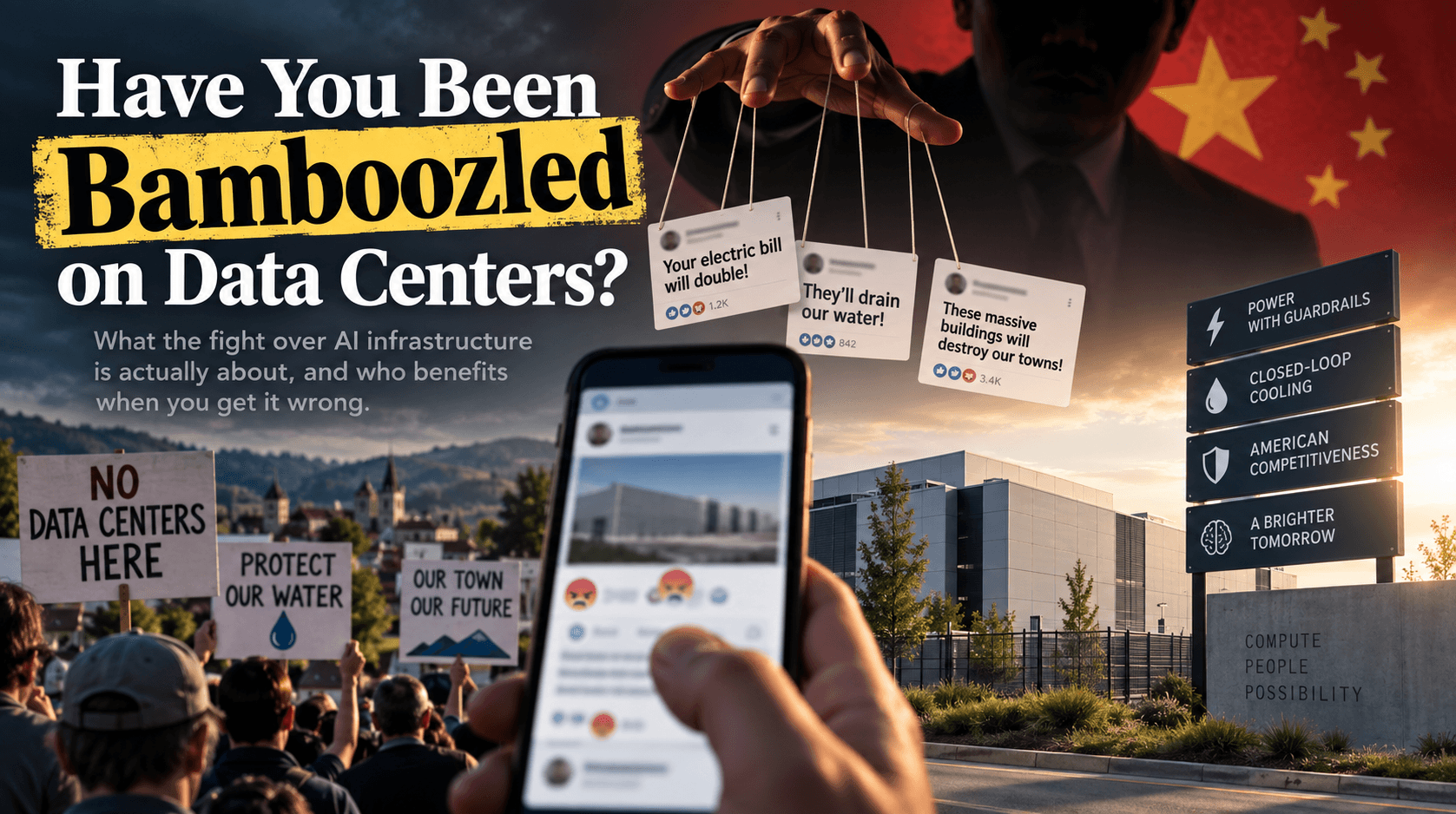
For six months I have watched people I respect share the same handful of talking points about data centers, and then watched councils vote to ban buildings nobody proposed. But is it based on data?
What the fight over AI infrastructure is actually about, and who benefits when you get it wrong.
For six months I have watched my Facebook feed fill up with data centers.
One post becomes a dozen. A dozen becomes a packed town hall. Then a city council votes to ban data centers in a county where nobody has proposed building one. These are not strangers. They are friends, colleagues, people I respect, people who are careful about most things, all repeating the same handful of lines with the same heat.
I want to be careful here, because I am not going to tell you that you are stupid. You are not, and some of what you are worried about is legitimate. I will get to that.
But I think a lot of us have been bamboozled. Not bought. Not recruited. Bamboozled, which is a different thing, and the difference matters.
Look at what was actually in those posts
Think about the specific arguments that spread fastest. Your electric bill is about to double. A corporation is going to drain the aquifer. Pictures of an enormous windowless building next to a small town, framed as an invasion.
In August, X's Global Government Affairs team announced it had identified hundreds of suspected Chinese accounts amplifying arguments against AI data centers. The accounts were part of a broader network of roughly 200,000 inauthentic profiles, and the ones aimed at AI infrastructure were pushing warnings about rising energy rates and imagery of corporations destroying communities.
Separately, back in June, OpenAI banned a cluster of accounts likely originating in China that were targeting American audiences with the claim that data centers make life more expensive.
Two different companies. Two different investigations. Same finding.
Now the part most people writing about this leave out
A few hundred fake accounts did not create this.
Only 24% of Americans say new data center construction is good for the country, and 47% say it is bad, according to Economist/YouGov polling. In Utah, opposition to one proposed project ran 60% against and helped end the career of the sitting Senate President. No bot farm builds numbers like that.
Taylor Barkley of the Abundance Institute put it plainly: claiming the social media debate is driven by the Chinese Communist Party overstates the case, and the bot findings should not be used to wave away the real concerns Americans have. He is right. Data centers are loud. Construction is disruptive. The largest facilities now being proposed for training AI models would draw up to 10 gigawatts, more than double the peak electricity demand of the entire state of Utah. If that is going up near your house, you are entitled to ask hard questions and get real answers.
Former Congressman Chris Stewart, who served on the House Intelligence Committee, made the same point from the other direction. You cannot stand in front of a community, tell them they have all been fooled, and expect that to work. Investor Kevin O'Leary tried something close to it and is now being sued by groups he accused.
So here is what I actually mean by bamboozled. Nobody hijacked your opinion. But the sharpest, angriest, most shareable version of the argument you are repeating was tested and amplified by people who benefit from you believing it, and it traveled a lot faster than anybody's ability to check it.
Why anyone would bother
I grew up in the seventies and eighties, at the peak of the nuclear arms race. I went to bed genuinely afraid that the Soviets would out-build us and that one day somebody would push the button and we would not have enough left to stop it. By the first Gulf War, we had added biological weapons to the list of things to lie awake about.
We are in an arms race again. Almost nobody talks about it that way, and it is not about warheads.
It is about compute. The models that advance fastest will own the data and the data flow. That means whoever is making the decisions about what your news looks like, how your kid's school runs, what your work tools do, how your market moves.
I spend every day in this industry. I see what these systems can already do, and I see the slope they are on. The upside is genuinely thrilling. The downside, without guardrails, is a technology that can be turned on a population by anyone with enough of it.
People get furious about how much we buy from China. Ask yourself how you would feel about buying your intelligence infrastructure from them.
The tell
Here is the part that convinced me something was off.
The Bitcoin Policy Institute, in its report on foreign influence in the AI debate, pointed out an asymmetry that is hard to explain away. Chinese state media outlets have spent months telling American audiences that data centers are an environmental and economic disaster. At the same time, the Chinese government subsidizes up to half the energy costs of its own AI data center operators.
You do not need to prove that anybody was paid. Just ask the obvious question. Why is the country telling us not to build racing to build?
The water question, answered honestly
I have seen the claim that data centers use closed-loop cooling and therefore water is a non-issue. That is not true, and I am not going to repeat it.
Most large modern facilities still use evaporative cooling, which consumes water outright. US data centers directly consumed 17.4 billion gallons in 2023, and that is projected to reach 38 to 73 billion gallons by 2028. Your concern about water is not a scare tactic. It is a design problem.
The good news is that the design problem is already being solved. Vantage's closed-loop campus in Wisconsin peaks around 22,000 gallons per day, compared with roughly 5 million for a comparable campus running evaporative cooling. Microsoft has committed to zero-water-evaporation designs across every facility designed since August 2024.
So stop asking whether to allow the building. Start demanding the cooling loop.
The same logic applies to power. Utah now requires large data centers to generate their own electricity on site, which can actually reduce rates for residents by adding supply. New York and Pennsylvania went the other way and restricted construction. One of those approaches gets you the compute and the protection. The other gets you neither, and the facility gets built somewhere else.
What we lose by getting this wrong
My father-in-law died of pancreatic cancer five months after his diagnosis. At that stage there is almost nothing anyone can do.
On August 5 of this year, Mayo Clinic announced that researchers had used AI to design a small molecule inhibitor targeting the PDZ domain of the GIPC1 protein, a target long considered undruggable. In laboratory studies it slowed tumor growth, improved survival, and made chemotherapy work better. It is preclinical. It is not a treatment you can get. The team is working toward a clinical trial.
But a protein nobody could touch is now something we can design against, and AI is why. That is the thing sitting on the other side of this argument.
What I actually want
Build the data centers. We need the compute, and if we do not build it here, the capability and the leverage that comes with it go somewhere else.
Demand the guardrails. Closed-loop cooling. On-site generation. Real disclosure on water and power before approval, not after. And regulation on the technology itself, which we need whether or not it is politically convenient to say so. No president and no single administration can personally supervise a technology whose capability compounds by the month. That is not a criticism of any one officeholder. It is the reason the guardrails have to be structural instead of personal.
And be a little suspicious of the post that made you angriest. Somebody may have spent real money making sure it found you.
For the practical side of this, how AI and automation apply inside an ordinary business, see our AI and automation services.


